DELL

- DELL EMC PowerEdge R740xd (24xSFF/RC1) Performance Rack Server with 2x Xeon Gold 6240 18-Core 2.60 GHz, 32 GB DDR4 RAM
- 4 in stock
- DELL EMC PowerEdge R640 (4xLFF/3xLP) Base Rack Server with 2x Xeon Silver 4116 12-Core 2.10 GHz, 32 GB DDR4 RAM
- 3 in stock
- Upgrades available
- DELL EMC PowerEdge R730 (8xSFF) Base Rack Server with 2x Xeon E5-2640v4 10-Core 2.40 GHz, 32 GB DDR4 RAM
- 10 in stock
- Upgrades available
- DELL EMC PowerEdge R640 (4xLFF/3xLP) Entry Rack Server with 2x Xeon Silver 4112 4-Core 2.60 GHz, 32 GB DDR4 RAM
- 3 in stock
- Upgrades available
- DELL EMC PowerEdge R740xd (24xSFF/RC1) Performance Rack Server with 2x Xeon Gold 6240R 24-Core 2.40 GHz, 32 GB DDR4 RAM
- 4 in stock
- DELL EMC PowerEdge R640 (4xLFF/3xLP) Entry SATA Rack Server with Intel Xeon Silver 4108 8-Core 1.80 GHz, 32 GB DDR4 RAM
- 3 in stock
- Upgrades available
- DELL EMC PowerEdge R640 (4xLFF/3xLP) ZFS-ready Rack Server with 2x Xeon Silver 4216 16-Core 2.10 GHz, 32 GB DDR4 RAM
- 3 in stock
- Upgrades available
- DELL EMC PowerEdge R640 (4xLFF/3xLP) Entry SATA Rack Server with Intel Xeon Bronze 3106 8-Core 1.70 GHz, 32 GB DDR4 RAM
- 3 in stock
- Upgrades available
- DELL EMC PowerEdge R750xs (8xLFF/RC0) Performance Rack Server with 2x Xeon Gold 5317 12-Core 3.00 GHz, 32 GB DDR4 RAM
- 1 in stock
- DELL EMC PowerEdge R740xd (24xSFF/RC1) Performance Rack Server with 2x Xeon Gold 6234 8-Core 3.30 GHz, 32 GB DDR4 RAM
- 4 in stock
- DELL EMC PowerEdge R640 (4xLFF/3xLP) ZFS-ready Rack Server with 2x Xeon Silver 4215 8-Core 2.50 GHz, 32 GB DDR4 RAM
- 2 in stock
- Upgrades available
- DELL EMC PowerEdge R740xd (12+12xSFF) Hybrid NVMe Rack Server with 2x Xeon Gold 6258R 28-Core 2.70 GHz, 32 GB DDR4 RAM
- 1 in stock
- Upgrades available
- DELL EMC PowerEdge R740xd (12+12xSFF) Hybrid NVMe Rack Server with 2x Xeon Gold 6254 18-Core 3.10 GHz, 32 GB DDR4 RAM
- 1 in stock
- Upgrades available
- DELL PowerEdge M630 (2xSFF) Base Blade Server with 2x Xeon E5-2680v4 14-Core 2.40 GHz, 32 GB DDR4 RAM
- 1 in stock
- DELL EMC PowerEdge R640 (4xLFF/3xLP) Base Rack Server with 2x Xeon Silver 4214 12-Core 2.20 GHz, 32 GB DDR4 RAM
- 3 in stock
- Upgrades available
- DELL EMC PowerEdge R640 (4xLFF/3xLP) Entry Rack Server with 2x Xeon Silver 4108 8-Core 1.80 GHz, 32 GB DDR4 RAM
- 3 in stock
- Upgrades available
- DELL EMC PowerEdge R740xd (24xSFF/RC1) ZFS-ready Rack Server with 2x Xeon Silver 4210 10-Core 2.20 GHz, 32 GB DDR4 RAM
- 4 in stock
- DELL EMC PowerEdge R640 (4xLFF/3xLP) Entry Rack Server with 2x Xeon Bronze 3104 6-Core 1.70 GHz, 32 GB DDR4 RAM
- 3 in stock
- Upgrades available
- DELL PowerEdge M630 (2xSFF) Base Blade Server with 2x Xeon E5-2650v4 12-Core 2.20 GHz, 32 GB DDR4 RAM
- 1 in stock
- DELL PowerEdge M630 (2xSFF) Base Blade Server with 2x Xeon E5-2620v4 8-Core 2.10 GHz, 32 GB DDR4 RAM
- 1 in stock
Buy refurbished Dell PowerEdge servers: Information and answers regarding refurbished Dell servers
- Dell PowerEdge servers for a wide variety of requirements
- Easily find the right Dell PowerEdge server through clear labelling
- Dell PowerEdge R-Series rack servers
- Dell PowerEdge T-Series tower servers
- Dell PowerEdge M-Series blade servers
- Advantages of refurbished Dell PowerEdge servers
- FAQ: Frequently asked questions about refurbished Dell PowerEdge servers
- Buy refurbished Dell servers at affordable prices from ServerShop24
Dell PowerEdge servers for a wide variety of requirements
The US company Dell Technologies Inc. is one of the leading providers of IT solutions, offering a broad product portfolio. In addition to PCs and notebooks, this includes professional storage systems, workstations and servers in various model series for enterprise use. PowerEdge series servers are available in various form factors and configurations, providing solutions tailored specifically to the respective application.
Easily find the right Dell PowerEdge server through clear labelling
To identify and classify them, all Dell PowerEdge models have a unique designation, which generally consists of a letter and three or four numbers. This nomenclature has been used since the 10th generation and contains various details about the form factor and performance of the systems. The letter at the beginning of the model designation defines the server's form factor:
- R: Rack server for mounting in a server cabinet or rack
- T: Tower server for use in offices and branch locations
- M: Modular systems such as blade servers with high flexibility and scalability
In model designations with three numbers, the first digit represents the number of processor sockets available and indicates the performance class of the systems:
- 1 - 3: one CPU socket
- 4 - 7: two CPU sockets
- 8: two or four CPU sockets
- 9: four CPU sockets
The second digit indicates the server generation, with 0 standing for the 10th generation. All subsequent model generations are defined consecutively with increasing numbers:
- 1: 11th generation
- 2: 12th generation
- 3: 13th generation
- 4: 14th generation
The third digit indicates the supported processor manufacturer. CPUs from the manufacturers Intel and AMD each require their own processor sockets. For example, socket 4189 can accommodate 3rd generation Intel Xeon Scalable processors, whereas socket SP3 is required for 1st to 3rd generation AMD EPYC CPUs:
- 0: Intel processors
- 5: AMD processors
Taking a Dell PowerEdge R740 server as an example, it can be deduced that it is a 14th generation rack server with two processor sockets that can be equipped with Intel Xeon CPUs.
If, on the other hand, the model designation of a Dell server consists of a letter and four numbers, a partially different meaning applies. Here, the first digit after the letter indicates the system class and the functional scope of the integrated remote management solution iDRAC (Integrated Dell Remote Access Controller):
- 1 - 5: iDRAC Basic
- 6 - 9: iDRAC Express
As with the three-digit naming convention, the second digit indicates the server generation. The third number provides information about the number of available processor sockets, and the fourth digit states the processor manufacturer.
Using the Dell PowerEdge R6415 server as an example, the designation shows that it is a 14th generation rack server with support for iDRAC Express that can be equipped with AMD processor models in one CPU socket.
Dell PowerEdge R-Series rack servers
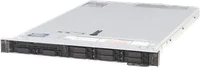
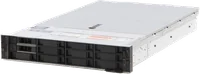
The rack servers in the PowerEdge R-series are designed for use in companies and data centres that require scalable, reliable systems with high performance. Various models, which differ in chassis height units and configuration options, offer performance and features for many areas of application. Due to technological advancements, the performance of the systems increases with each generation, with servers generally categorized into different model ranges depending on their optimal application. As designations ascend, the models differ in features such as the number of processors, maximum memory size, and the number of drive bays. Overall, Dell's PowerEdge R-series offers a broad portfolio of servers for diverse applications and workloads.
PowerEdge R200
The entry-level model of the PowerEdge R-series is often ideal for use in small businesses. The PowerEdge R200 rack server features one processor socket and four DIMM slots for RAM modules. The 19-inch chassis with one height unit (1U) also offers space for up to four hard drives and can accommodate expansion cards in two PCI Express (PCIe) slots. The system thus represents a cost-effective solution for less complex workloads and the provision of basic services.
PowerEdge R300
If the storage space and features of the entry-level model are insufficient for your application's requirements, the PowerEdge R300 server offers expanded capabilities. Differences include the number of drive bays and the option to use redundant hot-plug power supplies for increased reliability. These models are therefore suitable for processing larger amounts of data or serving as application servers.
PowerEdge R400
More demanding workloads, such as running databases and business applications, require IT systems with sufficient computing power. Featuring two processors, PowerEdge R400 models represent a solution for mid-sized companies and are also suitable for virtualisation applications.
PowerEdge R500
When processing growing volumes of data, 1U server solutions often reach their limits if a larger number of hard drives is required. Systems from the PowerEdge R500 model range are an ideal choice here, offering significantly more expansion potential in two-height-unit (2U) chassis.
PowerEdge R600
PowerEdge R600 server models combine the advantages of high performance and flexible customization with a compact footprint. The motherboard in the compact 1U chassis can accommodate two processors and allows for extensive memory expansion via numerous DIMM slots. Furthermore, configuring the system with different drive cages allows storage capacity to be flexibly tailored to high demands.
PowerEdge R700
As 2U high-performance servers, systems from the PowerEdge R700 model series frequently meet even the very high demands of large enterprises and data centres. Versatile configuration options, high computing power and high availability enable customised solutions to handle enterprise workloads efficiently.
PowerEdge R900
As top-tier models in the R-series, PowerEdge R900 rack servers offer peak performance, scalability and expansion potential in a four-height-unit (4U) chassis. A total of four processors deliver compute power, while memory expansion into the terabyte range meets the highest demands of virtually any application. For use in High Performance Computing (HPC), artificial intelligence (AI) and machine learning (ML), the systems can also be equipped with powerful graphics cards for compute acceleration, offering versatile adaptability to diverse workloads.
Dell PowerEdge T-Series tower servers
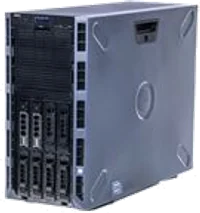
Tower servers in the PowerEdge T-series are often ideal for small and medium-sized enterprises with limited space for a complex IT infrastructure. Thanks to their compact chassis, these servers can easily be operated in office environments while providing performance, reliability and scalability for many application areas. As with rack servers, system performance increases with every hardware generation, and they are assigned to different model lines based on their performance class. Depending on the model and configuration, tower servers are suitable for use as file or web servers, as well as for demanding applications such as databases or virtualisation.
PowerEdge T100
As an affordable entry-level solution, the PowerEdge T100 model line meets many requirements of everyday workloads. Featuring one processor and four DIMM slots for memory, these systems often provide sufficient performance for use in small businesses or branch offices.
PowerEdge T300
To meet the growing requirements of expanding businesses, PowerEdge T300 models feature more powerful components for increased processing power and broader expansion potential. With more memory and a higher number of hard drives, these systems can be adapted to handle larger data volumes in growing business sectors.
PowerEdge T400
When versatile server solutions are required for database applications or virtualisation, the PowerEdge T400 model series often provides the required computing power with two processors. Thanks to powerful, redundant power supplies, the systems also offer enhanced fault tolerance and expansion capabilities. In addition, the tower chassis support rack installation, allowing flexible deployment across various IT infrastructures.
PowerEdge T500
To handle enterprise workloads and HPC (High Performance Computing) applications, PowerEdge T500 models can accommodate high-performance compute accelerators alongside two processors, delivering top-tier compute performance even outside of data centres. Various configuration options support the implementation of specific, tailored solutions for large organisations.
PowerEdge T600
Tower servers in the PowerEdge T600 range represent the top-of-the-line models in the series, meeting the requirements of virtually any enterprise or data centre application with high scalability, compute power and reliability. Extensive expansion options allow for flexible configurations regarding storage, memory and compute acceleration.
Dell PowerEdge M-Series blade servers
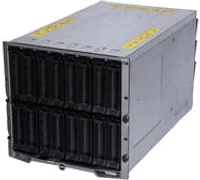
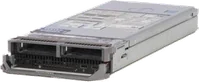
Modular systems in the PowerEdge M-series are ideal for enterprises and data centres requiring an efficient, scalable IT infrastructure. Combining high density, scalability and performance, they allow organizations to respond quickly and flexibly to changing business needs. The blade enclosure can accommodate multiple servers and additional modules in a space-saving manner, making it simple to add and manage further servers based on required capacity and performance.
To meet the demands of virtually any application, blade servers in the PowerEdge M-series are divided into different model lines, varying in compute power and potential memory capacity. Depending on the model and configuration, they are often ideal solutions for virtualisation and cloud computing. Entry-level models in the PowerEdge M400 series are already suitable for many virtualised environment and database applications, while the more powerful M500 and M600 models can be deployed for higher requirements. When peak performance is required for HPC applications, the PowerEdge M800 model line often provides an ideal solution.
Dell's PowerEdge M-series offers a broad range of models and configuration options to meet the needs of various applications. This makes the systems an attractive solution for businesses looking to maximise compute performance while using space and energy efficiently.
Advantages of refurbished Dell PowerEdge servers
- Lower procurement costs compared to new products
- Proven and established enterprise hardware
- Wide variety of models for almost any application
- Professionally refurbished and thoroughly tested server technology
- Sustainable use of resources
- Fast availability without long lead times
FAQ: Frequently asked questions about refurbished Dell PowerEdge servers
Which Dell servers are suitable for my business?
That depends on the intended use, required performance and available space. Dell PowerEdge rack servers are ideal for infrastructures with server rooms and data centres, for example, while tower servers can also be deployed in less complex IT environments and offices. Our support team will be happy to advise you on selecting suitable Dell server solutions for your business.
Can refurbished Dell servers be upgraded later?
Yes. Dell PowerEdge models offer expansion options for memory, drives, network cards and other components. However, which specific upgrades are possible depends on the specific model and hardware generation. The technical documentation for Dell servers contains detailed information on compatibility and supported hardware standards.
Which operating systems are supported by Dell PowerEdge servers?
The supported operating systems depend on the server model and its generation. On the product page of each Dell server, you will find a list of compatible operating systems alongside configuration details.
Which hard drives (SFF / LFF) can be used in Dell servers?
The chassis variant of the server and optionally available drive cages are crucial when planning storage with suitable hard drives. SFF (Small Form Factor) variants accommodate 2.5-inch drives and are often ideal for fast SSDs. LFF (Large Form Factor) variants offer space for 3.5-inch drives, enabling the use of high-capacity HDDs.
Buy refurbished Dell servers at affordable prices from ServerShop24
Expanding business areas and growing volumes of data frequently increase the demands placed on a company's IT systems. Thoroughly tested Dell servers from our online shop offer a cost-effective alternative to expensive new systems for expanding your infrastructure. This allows your IT budget to benefit from the excellent value for money of refurbished Dell server hardware, while the environment benefits from sustainable reuse that protects scarce raw resources.
We have been your expert partner for professionally refurbished used servers, storage systems, workstations and network equipment since 2010. In addition to a large selection of pre-configured servers from well-known brands ready for immediate dispatch, we also offer an extensive range of compatible components and spare parts for upgrading your systems. Fast dispatch from our large inventory ensures short delivery times, enabling you to use your order to optimise your IT infrastructure without long waiting times.
Do you have questions about products or individual configuration options? Our friendly and experienced support team will be happy to assist you! Contact us - together we will find the right Dell server solution for your application!